














.png)



A MELODY BORN FROM COOPERATION
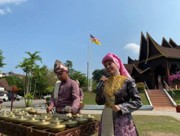
At first, the noises you produce might sound awkward. A few strikes, silence afterwards, followed by a few more strikes. It doesn’t sound like a song at all. However, the moment the player next to you joins in with their part, filling in those empty spaces, something captivating happens. A complete melody emerges in an instant. That melody isn’t solely yours, nor is it solely to your friend, it exists only when both part are played together. That’s the beauty of bertingkah technique, which is the core foundation of caklempong that places cooperation into the very heart of the performance.
Many people assume that to play traditional musical instruments, one must possess a special talent by being able to read music notes or have been practicing it since childhood. In reality, that assumption doesn’t hold true, at least when it comes to caklempong. Each of the bonang has its predetermined pitch. Players do not need to tune or hammer the instrument, arrange complex finger positions or control their breath like a serunai player. All you they have to do is to tap the pencu or combing on the top of the bonang using a wooden beater or pemalu and the right pitch rings out effortlessly.
The real challenge is not merely producing a note, but producing a sequence of notes at precisely the right moment. Players must know when it is the right timing to enter, when to hold back, and how to blend in and synchronize their part with the rest of the ensemble. This skill does not rely on innate talent, rather, it is shaped through consistent, repetitive practice and ideally if it is sustained over a longer period.
The uniqueness of the caklempong also lies in its nature as a group performance. It cannot be played alone because each instrument has complementary functions. Gereteh carries the main melody. Tingkah plays chords and fills the rhythm. Saua produces repeating patterns on low notes, while Canang plays the bass part. The gendang ibu and gendang anak alternately interlock (bertingkah) to control the overall tempo. Additionally, it's more interesting if a Gong is added to coordinate tempo, and a Pupuik (a type of small serunai made of bamboo) is included.
This sequence makes every single player indispensable. Unlike most group activities, which can usually proceed even when a member is absent, the loss of one player in a caklempong ensemble leaves an audible void. While this might slightly daunting, it also carries a profound meaning that every member is truly essential and plays a role that should never be underestimated.
Another advantage is that newcomers don't have to wait years before getting a chance to perform. Since the difficulty level varies across each part, they can begin training on the simpler sections while steadily building the skills needed to master the melodic lines. Moreover, the caklempong can be performed into various configurations to suit different events. It can be carried during perarakan, placed on a tepak berkaki for stage performances, or played while sitting cross-legged or standing upright using the instrument's base for more intimate performances closer to the audience.
The question then arises: what songs can actually be played on the caklempong? Many still assume that traditional instruments are only suited for old and traditional tunes. Initially, the caklempong used a pentatonic scale system which consists of five notes. However around 1970s, its system was expanded to seven-notes diatonic scale. This shift opened up possibilities for the caklempong to accompany a wide variety of modern songs without losing its distinct identity.
In fact, one of the distinguishing features between the Malaysian caklempong and the Talempong of West Sumatra is the use of accordion, which is an instrument of Western origin. The presence of the accordion serves as clear evidence that the art of caklempong has long embraced external elements and adapted them to fit the local identity. This is a tradition that constantly evolves with the times, yet never abandoning its cultural roots.
Although the room for modern adaptations remains wide open, renowned caklempong figure Pak Yuzi (Yuzaimuddin Md. Yusof), cautions that innovation shouldn’t erase the music’s original identity. The best approach is to master the traditional repertoire first, before venturing into more creative contemporary compositions or arrangements.
This caution stems from the genuine concern over the survival of this heritage.
On 17 August 2018, caklempong was officially recognized as Warisan Kebangsaan under the National Heritage Act 2005. Yet despite this official recognition, the number of inheritors of this art is steadily declining. That’s precisely why Pak Yuzi himself actively teaches primary school students to ensure that this legacy continues unbroken for the next generations.
For the younger generation, this situation actually opens up a great opportunity. The ability of performing caklempong is now a rare skill. Possessing such a unique and uncommon talent can set a per

.png)






.jpg)




.jpg)