By: Farhah Fakhrudin
In today's work environment, stress is often regarded as part of the daily routine. It manifests in the form of tasks arriving simultaneously from multiple directions, urgent demands that must be fulfilled immediately, and last-minute instructions requiring swift action with little room for delay. For many employees, stress is seen as a natural part of building a career. However, behind all this lies an important question that is often overlooked: is this stress actually helping, or silently becoming a burden?
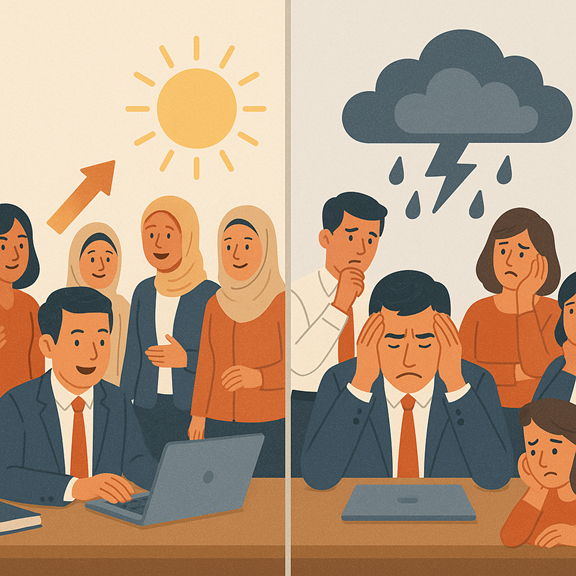
Stress does not necessarily have negative effects. In psychology, constructive stress is known as eustress, a healthy form of pressure that motivates individuals to stay focused, plan more effectively, and improve performance. For example, stress before an important presentation can make someone more meticulous and prepared. Stress that comes with new challenges can spark the drive to learn and grow.
However, the line between constructive and destructive stress is often blurred. Stress can become toxic when it is constant, stems from uncontrollable sources, and is reinforced by a cold, rushed work environment with a “survival of the fittest” mentality. In such situations, stress turns into an invisible weight—silently suffocating and causing long-term impacts on mental and physical health.
Unfortunately, in many organizational cultures, stress is used as a benchmark of strength. Those who can “endure” are seen as more capable or professional. In reality, many people suppress their feelings, adapt out of necessity, and gradually lose motivation. An unbalanced workload, poor communication, and a lack of space for voicing concerns turn stress from a challenge into a silent threat that slowly erodes inner capacity.
Leadership and organizational structure play a vital role in shaping how stress is experienced and managed. A healthy organization is not one without stress, but one that provides the support to manage it. It begins with clarity in task delegation, fairness in workload distribution, and a work environment that encourages mutual understanding and openness. In such settings, stress still exists—but it is controlled, discussed, and not excessively burdensome.
Employees also play an important role in managing stress. Identifying early warning signs such as extreme fatigue, lack of focus, helplessness, or emotional instability is the first step. The next step is having the courage to set boundaries and speak up—without fear of being labeled as “weak” or “unable to cope.”
Ultimately, stress is just one element in a career journey that can either be a driving force or an obstacle, depending on how it is addressed. It has the potential to motivate positive change—but can also become a destructive burden if ignored.
Balance is the key. We cannot eliminate stress entirely, but we can shape healthier work practices where people are not only judged by what they achieve, but also by how they are cared for while achieving it.
Date of Input: 16/06/2025 | Updated: 23/06/2026 | nureedayu
MEDIA SHARING










.jpg)