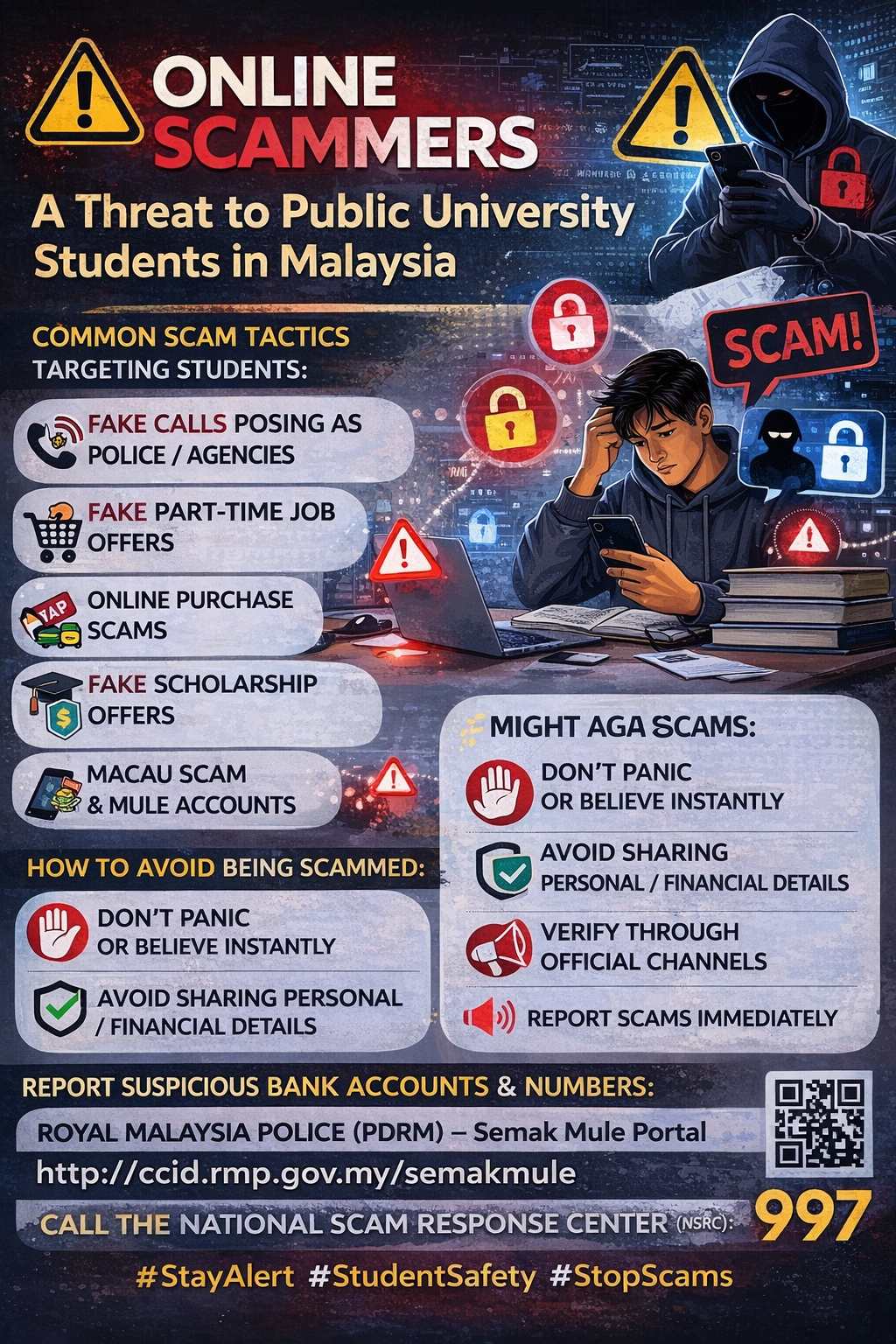
Online Scammers: A Threat to Public University Students in Malaysia
In today’s advanced digital era, online scams are becoming increasingly widespread, and one of the main target groups is students in Malaysian public universities (IPTA). The rapid development of technology and easy access to personal information have made university students vulnerable to various forms of fraud that can result in significant financial and emotional losses. This issue is becoming more serious and requires immediate attention from all parties, including educational institutions and authorities.
One common tactic used by scammers is impersonating police officers or institutional representatives. For example, a public university student in Jasin suffered a loss of RM38,000 after being deceived by a Macau Scam syndicate that falsely claimed the student was involved in money laundering and drug-related investigations. In addition, some syndicates offer fake part-time job opportunities to students, particularly through e-commerce platforms and social media. A student in Johor Bahru lost more than RM18,000 after being misled by promises of high commissions from online work.
Another popular scam involves fraudulent phone calls. Syndicates impersonate well-known companies or authorities, such as the police, to intimidate victims. A student in Terengganu reportedly lost RM64,200 after receiving a fake call claiming involvement in criminal activities. There are also online purchase scams, where students fall victim after making payments to fake sellers promoting discounted items such as mobile phones and auctioned motorcycles on Facebook.
Scams involving fake scholarship offers are also on the rise. Recently, a first-year student at a public university nearly became a victim after being offered a RM4,000 scholarship through Telegram. The student was asked to pay a RM200 upfront fee and provide personal information before realizing it was a scam.
To avoid becoming victims, public university students must remain cautious of any suspicious calls, messages, or offers that seem unrealistic. Do not panic or immediately believe claims that you are involved in criminal activities or required to make payments to resolve an issue. Students should avoid sharing personal or financial information with unknown individuals and always verify the legitimacy of offers through official channels. The Royal Malaysia Police (PDRM) Semak Mule portal can be used to check suspicious bank account and phone numbers. In the event of a scam, victims should report immediately to the authorities or contact the National Scam Response Center (NSRC) at 997.
In conclusion, online scams pose a serious threat that requires urgent awareness and proactive measures. Public university students must be equipped with sufficient knowledge and awareness to face increasingly sophisticated scam tactics. With vigilance and collective support from all stakeholders, this issue can be effectively addressed and prevented from spreading further.
Date of Input: 28/02/2026 | Updated: 29/04/2026 | nureedayu
MEDIA SHARING









.jpg)